
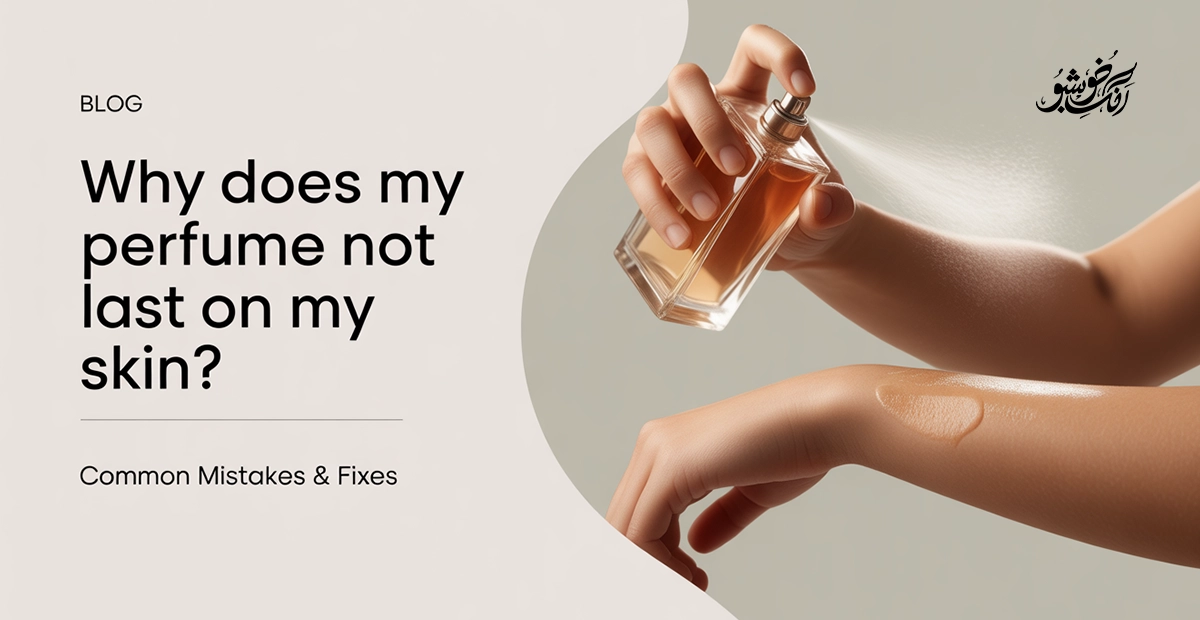
Why Does My Perfume Not Last on My Skin?
You spray your favorite fragrance before leaving home. It smells perfect. Fresh. Confident. Expensive. But by the time you reach the office, it feels like it disappeared. And then the question hits you: Why Does My Perfume Not Last on My Skin?
This is one of the most common fragrance problems worldwide. From Karachi’s humidity to Lahore’s dry winters, people everywhere struggle with perfume longevity. The truth is simple: perfume performance depends on multiple factors, such as your skin type, climate, fragrance concentration, and even how you apply it.
Let’s break everything down clearly and practically so you can finally make your fragrance last longer.
How Perfume Actually Works on Skin
Before fixing the issue, you need to understand how perfume behaves. A fragrance is made of three layers:
- Top Notes: Light and fresh. They evaporate first.
- Middle Notes (Heart Notes): The main body of the scent.
- Base Notes: Heavy molecules that last the longest.
Perfume longevity depends mainly on base notes and how well they bind to your skin. If your perfume fades quickly, it usually means:
- The base notes are light (like citrus or aquatic scents).
- Your skin is not holding the fragrance properly.
- The environment is accelerating evaporation.
Understanding this foundation helps you solve the real problem instead of blaming the perfume immediately.
Your Skin Type and Perfume Longevity
One of the biggest reasons perfume does not last is dry skin. Perfume molecules need oil to hold onto. When your skin lacks natural oils, fragrance evaporates faster.
How Different Skin Types Affect Perfume
| Skin Type | Effect on Perfume | Explanation |
| Oily Skin | Long-lasting | Natural oils trap fragrance molecules |
| Normal Skin | Moderate lasting | Balanced oil levels |
| Dry Skin | Fades quickly | No oil barrier to hold scent |
In Pakistan, especially during winter, dry skin becomes very common. That’s why many people complain their fragrance disappears faster in colder months. What You Should Do
- Apply an unscented moisturizer before spraying perfume.
- Use body lotion or petroleum jelly on pulse points.
- Consider using fragrance oils if your skin is extremely dry.
You’re Using the Wrong Perfume Concentration
Not all perfumes are designed to last all day. Perfume strength depends on oil concentration.
| Type | Oil % | Average Lasting Time |
| Eau de Cologne | 2–4% | 1–2 hours |
| Eau de Toilette | 5–15% | 3–5 hours |
| Eau de Parfum | 15–20% | 6–8 hours |
| Parfum (Extrait) | 20–30% | 8–12+ hours |
You Are Applying Perfume Incorrectly
Many people complain that their fragrance disappears quickly, but the real issue is not the perfume; it’s the application method. Perfume is not just something you spray randomly. It reacts with your skin, body heat, and air.
If you apply it incorrectly, you reduce both longevity (how long it lasts) and projection (how far it smells). Let’s break this down clearly.
Common Mistakes That Reduce Perfume Performance
1. Rubbing Wrists Together After Spraying
This is the most common mistake. When you rub your wrists together:
- You create friction.
- Friction produces heat.
- Heat breaks down delicate top notes.
- The fragrance structure gets disturbed.
2. Spraying From Too Far Away
Some people spray perfume from a long distance, thinking it spreads better. But when you spray from too far:
- Much of the perfume evaporates in the air.
- The fragrance mist becomes uneven.
- Less product actually reaches your skin.
3. Spraying Only Once
If you are using Eau de Toilette or a lighter fragrance, one spray is usually not enough. A single spray may:
- Stay too close to skin
- Fade within 2–3 hours
- Not create noticeable projection
4. Applying on Dry Skin
Dry skin absorbs fragrance quickly and causes faster evaporation. If your skin lacks moisture:
- The perfume has no oil layer to hold onto.
- The scent disappears faster.
- Projection becomes weak.
The Correct Perfume Application Method
Now, let’s discuss the proper technique clearly and practically.
Step 1: Start With Moisturized Skin
Apply an unscented lotion or light body cream first. Why? Moisturized skin:
- Holds fragrance molecules better
- Slows evaporation
- Improves overall performance
Wait 1–2 minutes before spraying perfume.
Step 2: Spray at the Right Distance
Hold the bottle about 5–7 inches away from your skin. This ensures:
- Even distribution
- Proper mist formation
- No concentrated alcohol spots
Avoid spraying too close (it becomes too strong in one area) or too far (it evaporates mid-air).
Step 3: Apply to Pulse Points
Pulse points are warm areas where blood vessels are closer to the skin. Heat helps diffuse the fragrance slowly throughout the day. Best Pulse Points:
- Neck
- Behind ears
- Wrists
- Inner elbows
- Behind knees (optional for events)
These areas help the perfume project naturally as your body temperature rises.
Step 4: Do Not Rub
After spraying, let it dry naturally. Rubbing:
- Breaks fragrance molecules
- Reduces top note freshness
- Affects scent development
Step 5: Lightly Spray on Clothes (Optional)
Fabric holds fragrance longer than skin. However:
- Avoid delicate fabrics like silk.
- Spray from a slight distance.
- Test first to prevent staining.
This helps increase longevity, especially in hot climates.
Why Proper Application Matters
When you apply perfume correctly:
- The fragrance develops properly in stages.
- Projection improves.
- Longevity increases by several hours.
- The scent smells smoother and more refined.
Incorrect application can reduce performance by 30–50%, even if you’re using a high-quality perfume.
Fragrance Notes Also Matter
One major reason people ask, “Why does my perfume fade quickly?” is that the type of fragrance notes used in the formula. Not all scent families are designed to last long. Some notes are naturally heavy and slow to evaporate. Others are light and disappear quickly.
Perfume longevity depends largely on the molecular weight of ingredients:
- Heavier molecules → Slower evaporation → Longer lasting
- Lighter molecules → Faster evaporation → Shorter lifespan
Below is a clear comparison to help you understand.
| Notes | Why They Last (or Fade) | Best For |
| Oud | Heavy resinous wood with deep molecular structure | Formal events, evenings |
| Amber | Warm, rich, and dense composition | Winter, night wear |
| Vanilla | Sweet but thick base note | Cozy, romantic settings |
| Musk | Deep, skin-like scent that binds well to skin | Daily wear, layering |
| Patchouli | Earthy and strong with slow evaporation | Bold, signature scents |
| Aquatic | Clean, watery composition with airy structure | Gym, casual outings |
| Green Notes | Fresh-cut grass-type molecules evaporate quickly | Spring, light daily use |
| Light Floral | Soft petals with a delicate structure | Daytime events |
Frequently Asked Questions
Final Thought
Perfume longevity isn’t just about the fragrance itself; it’s about how you apply it, your skin type, and proper care. By moisturizing, spraying on pulse points, choosing stronger concentrations, and storing your perfume correctly, you can enjoy a scent that lasts all day. Small changes in your routine make a big difference, letting your favorite fragrance shine the way it was meant to.